A Confession: Rhythm

Part of my New Year's resolution is to simplify my life. To that end, I've been trying to formulate a few watchwords that sum up what I'm trying to achieve with my little existence.

One of those words is rhythm. What I think that word captures is an idea of persistence, with variation. It's brings to mind this idea of "keeping on a path", without sounding tedious. Not only that, but it also evokes the notion of timing, where every action has its appropriate place. I'm not sure I've been heeding the rhythm of life, so to speak.  I'd like to start.

I am also paying attention to rhythm in a more literal sense. As you hopefully know, I write music, and when I do so, it is with a focus on rhythm... without any personal skills at keeping it.  That is, I quantize nearly everything. It's a crutch. I'd like to change that, so I'm starting to practice keeping rhythm and quantizing less. I've even started recording myself tapping out rhythms live.  (Though I admit, I've been looping those samples rather than playing long stretches!)

All of this talk is fancy padding around the admission that I've gone and done something... a little silly. You see, my son got a bunch of money for Christmas. While he initially wanted to spend this on a PSP, my wife and I convinced him that this was a bad idea (he already has a GameBoy, a DS, a Wii, a PC, and access to my PS3... he doesn't need another system). Recently, he's taken to playing Rock Band at his friend's house, and we thought it would be a better use of his money if he went and bought a copy of his own... then he'll be better when playing at the friends house, and so on.

Well... I upgraded his purchase from the basic set to the full band thing, so that it included the little drum set.

Yes, yes.  I have been playing Rock Band drums.  I admit it.

And, dammit, it's fun.

...And also?  Really hard.

Towards a Liberal Morality Part II: Loyalty

Some months ago, I touched on the idea that liberal morality may not have the "holes" in it that Jonathan Haidt suspects. I started by saying that the English meaning of "purity" is slanted toward the right. I want to expand on this broader subject.

Haidt also talks about "minimizing harm" as a moral measure, and both sides of the political spectrum subscribe to it (the left somewhat more so).  I think this concept is spot-on.  Not much to talk about, here.

The next interesting concept in Haidt's study is that of "loyalty", and again this is one of those morals that the Right seems to have corenered the market on.

But, again, I think a subtle shift in terminology may reveal otherwise.  The Right's concept of "loyalty" seems to me to encompass the act of following one's leaders. I think Haidt's definitions includes a clause about "deserving leaders", or some-such.  So, for example, it's okay to question (for example) President-elect Obama, on grounds that he doesn't deserve his role as leader.

The Right can have that definition of loyalty. It's inane.

For me, what "loyalty" means is advocating continuous improvement of the group. Loyalty requires critical analysis, self-measurement: supporting a group without improving it is empty support. I think you'll find that liberals have this "critical loyalty" in spades... so, again, Haidt's political imbalance would disappear.

So, again, loyalty is a word I would like to see the Left re-claim.

Big Mind

I'm going to take a bit of a risk in posting this, but:


...I've made a reputation for myself as a skeptic and an atheist; I am.

But Roshi's train of thought is something that I feel is remarkable. While I think he gets a few observations about "big mind" wrong, the point is still amazing, and this is a technique that I think everyone who cares about practical philosophy* should be familiar with.


* Is that an oxymoron?

Films

Today, I was sick.  So I played a little (more) Oblivion, slept as much as I could, and watched the last of the "Three Colors" films, Red.

(I watched White a few days ago.  It was good, but didn't really do anything for me.)

It was good.  Not nearly as good as Blue, but with a slightly grander scale and meaning. I recommend it, but (obviously) not as highly as Blue.

I would like to watch more movies in the vein: really well-done films, imbued with meaning, well-shot, and superbly acted.  If you have suggestions, please let me know.

Currently in my queue are Jaane Bhi Do Yaaro, a Hindi comedy, Léon, the classic French action film (yes, it's true, I haven't seen this yet), and Vozvrashcheniye, a Russian film about a father who returns to his sons after being gone their entire lives.

I'm not specifically looking for foreign films... it's just more likely that I haven't seen them, as opposed to the independent American films, which I've seen pretty much all of.  (...and rather like, mind you!)  ; )

Recommendations appreciated. Obscure is probably better (less likely to have seen), but it must be well-acted and with good cinematography.  I'm not in a forgiving (of quality) mood.  No "you've gotta watch Cube!", please.  ; )

Thanks.

Now Try Coughing

I just watched the move "Three Colors: Blue".

Best film I've seen in a long, long, long time.

Made me cry.

[sniff]

What Makes Someone A Friend?

Scott Adams asked the question, and answered it with insight. Please read his thoughts.

No, not psychically!


I think I will try this out.

Worst. Commercial. EVER.

I hate commercials.

No, I mean I really fucking HATE commericals.

That is, I hate the bad ones.  I'll chuckle at a clever commerical, and can bear the others that just get to the point.  But a bad commercial has been known to evoke violence in me.

Well, now I've seen the worst commercial in history.  So maybe I can finally let it go.

...But not without one last act of violence: inflicting this commercial on YOU, dear reader...


Terrifying Thought

Some time ago, Seth Godin posted about Malcolm Gladwell's essay on music students. One study found that top students outperformed lesser students because of the amount of time, in total, they had spent practicing.

The magic number seemed to be 10,000 hours. That is to say, 10,000 hours of practice puts you at the top of your field. (At least for music, though Gladwell argues that it generalizes well.)

Godin came up with a few exceptions, but that's not what I want to focus on. What I want to focus on are the terrifying realizations I had after churning on this idea for a few weeks.

First, I decided that I haven't spent 10,000 hours doing anything. Not even writing code*. And maybe I should start focusing more.

Then I realized, with horror, I have spent 10,000 hours doing some things:

  • Playing computer games
  • Watching TV
  • Surfing the damn internet

Well, shit.


* Honestly, I've been a developer for about 11 years, which should put me around 20,000 hours! But developers spend--easily--less than 25% of their time actually writing code. ...I hope that I can add to that the many hours I spent coding for fun in my youth. Thus I'd like to think I'm close.

Korean insults?

나무를 껴안는 긴장성 분열증 원숭이 먹는 사람 !

Medical Tidbit

I'm currently working on a job (consulting) dealing with medical costs.  While looking up some information on one of the terms, I found this interesting tidbit of information:

In 1991, the top 10 [categories for inpatient care] overall were: normal newborn, vaginal delivery, heart failure, psychoses, cesarean section, neonate with significant problems, angina pectoris, specific cerebrovascular disorders, pneumonia, and hip/knee replacement. These DRGs comprised nearly 30 percent of all hospital discharges.

...In other words, those are the everyday things that bring people to the hospital for inpatient care.

[shrug] I thought it was interesting. A day-in-the-life kind of thing.

Port Part Two

After finishing my bottle of Old Cave port just before New Year's, I decided to read up on the subject.  I won't bother giving details here: basically, I read the Wikipedia article. I'll start, though, with the most basic fact: port is made by adding (neutral) brandy to fermenting wine. This stops the fermentation process, leaving much of the sugar from the grapes, giving it the sweet taste... and upping the alcohol content significantly. (Brandy is distilled wine, and has a very high alcohol content.) I also did a little hunting and came up with a "to try" list of ports, ranging across the spectrum of types and labels.

I was showing this list to a friend of mine on New Years, and he decided he and I were going to each buy a bottle--this was around 10:00--and try it.We zipped over to his packing store of choice (he's a Scotch drinker and his wife like cocktails), and looked around... they had an excellent selection. He settled on a Late-Bottled Vintage (LBV), though I had to convince him that buying an actual Vintage would be (relatively speaking) a waste of money. Basically--a vintage is a "true" port: a single harvest of grapes, aged for about 18 months, then bottled. They tend to be very expensive because of their limited supply. LBVs, on the other hand, are created when a harvest for vintage wine was not in high enough demand, and so the port sat in the cask longer than 18 months.  It's still a single harvest, but it has a "nuttier" taste because of the extra time with the oak.

I grabbed a sexy-looking bottle of ruby, since this meant that we'd be able to try three of the four common varieties of port (because the bottle he'd gotten me for xmas was a tawny--a mixture of several harvests, each aged for decades).  Ruby is a very different kind of port: not aged in oak casks at all. It does not improve with age.

 We did this because we're both aware of a very nice tawny, and wanted to try these other (common, cheaper) varieties of port.

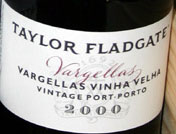
The LBV he picked up was Taylor Fladgate 2000, which cost $23, and we opened that first because I assured him it would be the better of the two. And, indeed, it was fantastic. Both of us took our first sips and just smiled and said "wow". We immediately agreed that this was much better than the tawny (which is also superb, mind you). Much smoother, much more satisfying. Not nearly as complex, though... and nothing of, as they say, "a finish". It's just a great-tasting drink.  : ) The tawny is something you drink in tiny sips over a long period of time, because the best part is the aftertaste... but this LBV was something you could drink much faster.  Sipping is still appropriate, but it's not long before the taste fades.

Absolutely worth the $23. I'll certainly be buying a bottle of it when I have a chance, and I recommend it even more highly than the Old Cave.  It's something everyone who might like port should try.

The second bottle (the one I bought) was a $20 Graham's Six Grapes (which is ruby. Rubies don't have a year or age designation because it doesn't really matter.) I went in expecting this to be a much simpler drink, probably with a bright red color.  I was a little surprised at just how dark it poured out, though: maroon, not red, and very opaque. It was noticably thicker than the other two... really thick legs on this one. A very sexy-looking drink.  : ) ...But I'll admit, it didn't impress me nearly as much as the Taylor. It was even further down the "drinkable" spectrum than the LBV: this was essentially grape juice with a kick. ; ) My friend said "I could drink an entire bottle of this"... and that's true: it's very easy to drink. I'll admit I enjoyed it (and even more so as the the glass emptied), but I won't buy this again: it lacks the intricacy of the others that are what drew me to port in the first place. My friend claimed he liked this one more than the Taylor, but I find that hard to believe. I think he was being nice.  ; ) (And, as evidence, he poured himself a second glass of the LBV an hour later.  Heh.)

The last thing he said was "it's hard to believe these three drinks are from the same family"... which may be slightly over-stated (they're all sweet, strong wines) but has some truth to it: they are three very different experiences. The ruby is just a great drink, the LBV's a perfect dessert drink, and the tawny is a sipping experience. And, from what I've learned, they are three very different methods to create... so I think it's fair to say they should get a bit more recognition as separate entities.  There's probably as much difference between them as between any of the "types" of wine out there (of which I am ignorant, sorry).

So... one of my resolutions this year is to try a list of new ports: about one a month (my ports-to-try list is 14 items long). While I have no urge to become "a drinker" (despite more drinking in a week than I've done in my entire life, I've still never been drunk*), there are some ostensible health benefits, and I do enjoy the occasional experience.  ; )


* Actually, on Christmas Eve and again on Christmas Day, I ended up with "a buzz"... which was a first. I doubt I'll get to that point again, though.