Showing posts with label rpg. Show all posts

But That's What My Character Would Do! (Rant)

What single element that ruins role-playing games for me is that battle-cry among role-players: "That's what my character would do."

[sigh] I can't say I have ever heard that uttered, not once, and had something good happen to the game as a result of it. Period.

What's more, I don't think I've ever heard it uttered and be true.

Characters don't betray their friends, they don't attack someone just for insulting them (by far the most common mistake), they don't go wandering off alone (leave that to the NPCs), they don't ruin the party's endgame: they make sacrifices for the good of the outcome, whatever that may be. Yes, they might do it kicking and screaming, and that's all good. But, no, that's not what your character would do. He would suck it up and trudge on. ...Assuming your character is a hero, that is. Many good stories use such devices for antiheroes. If that's what you see your character as, so be it. Let's change the dynamic of the game and make it about your fall from grace. ...But I don't think that's what these players have come to the table to see.

I will briefly pause to interject: I have seen one player pull of an anti-hero successfully. But he established early on that he was doing it, and he never, ever uttered that phrase. We knew what his character would do, and we had fun with it as a result. He was the complication.

My mantra?

For a good game, your hero's priorities should be secondary to the storyline.

Role-Playing Lifecyles: Enjoyability versus Predictability

My experience has been that a typical RPG runs a fairly predictable social curve. (Of course I mean a game that isn't doomed from the start, which may in fact be more typical than not.)

The first session is always about potential: players are shy, characters are ill-defined, the system begins its exposition. Some players have already decided whether or not they are going to enjoy the game... but I think for the most part, people leave their opinions open after the first session, in a wait-and-see attitude.

The next few sessions--three, perhaps--build up to a climax of enjoyability, as characters start to develop, players learn one another's quirks, and the plot of the game gets underway. I've often seen characters trying out vastly different kinds of things in the first few sessions: usually starting out on the timid end of the spectrum, and gradually growing more bold. The fun of these sessions is still largely about potential, since the possibilities are still endless.

...But those multitudinous futures must, of course, be culled to a single destiny for the characters. (Image is (C) Sci-fi channel, used without permission.) Soon, the outcome becomes imperative, and the players become more tense... often (always?) because the players are unclear about the "correct" path to success. Sometimes they have differing ideas on how to achieve the goal, and are unwilling to compromise. And by this time (we're six-or-so sessions in, I guess), personalities also begin to clash, as each player gets perturbed by the others' predictability.

The honeymoon is over. What happens here has always disappointed me: the players become stuck in their roles; forward momentum is stifled. Idle chatter increases, as the players no longer anticipate what is going to happen next in the game. Players are more likely to miss sessions. Players have their characters do obnoxious things (and I will go into one of these in my next post).

What happens from there is highly variable. Some games make it, some fizzle and suffer awkward deaths. Some become campaigns. And those, I find, are often helped--not hindered--by the addition of new players. They help begin the curve again,. in my experience.

So the next time someone asks to join your game, tell them they can come in around the sixth or seventh session.

Best. NPC. Ever.

Sometimes a player character is interesting enough to make the game (Farvin in our Friday night game, Kelly in our Continuum game), and sometimes the cast of characters interacting make the game (as in our Amber game, where infighting was what kept it most amusing). But when those fail (and they are rare and precious), for my money at least, NPCs make the game.

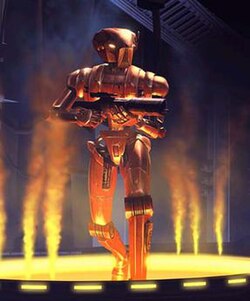
This is, for obvious reasons, especially true for computer role-playing games. And of the games I have played, there is not a single NPC that comes as close to being perfect as HK-47. Ostensibly, HK-47 was simply comic relief. ...But, shy of the Jedi if you roll that way, he was the single best character to bring into combat, since you were an infighter, and he was a very skilled ranged fighter.

I also have a weak spot for droids.

I will often tell people, with great conviction, that you should play KOTOR for no other reason than to experience HK-47. Yes. He's just that good. ...Really, what isn't there to love about a psychotic, sarcastic assassin droid?

[while dealing with Jawa:]

Revan: Can you help me out here, HK?
HK: I'm 98% percent sure this miniature organic meatbag wants you to help find his fellow miniature organic meatbags.
Revan: And the other 2 percent?
HK: The other 2 percent is sure that he is just looking for trouble and needs to be blasted, but that might be wishful thinking from my part.

This week, I played Portal. It's a short game, so it was something I did in a single evening. I was looking forward to it, because the AI that guides you through the game was supposed to be an excellent NPC, for many of the same reasons as HK-47: sadistic, sarcastic, and humorous. ...And I did laugh quite a few times while playing it, particularly at the ending credits. (And, by the way, it's an excellent game.) But it didn't have the same magic as HK-47.

The Main Character Theory of Role Playing Games

Role-playing games, given a modest amount of time, will develop a main character.

This goes counter to one of the implicit objectives of running a game: namely, the idea that every player should be included equally. However, in my experience, it is unavoidable: there will be one character from who's perspective the story is most compelling, and without whom the overall story suffers.

Sometimes, this is the most vocal player, for obvious reasons: they contribute most to the storyline, by directly affecting it. The game I'm running right now features a character named Jokamo, and he does most of the talking, and thus the game seems to be from his perspective. Each character he's with is a strong one: a snarky wood-elf, a mage with the ability to take down tall buildings with a single evocation, and... uhhh... a quirky half-height mystic who likes to wear cups for hats and keeps a magical talking skull on her shoulder.

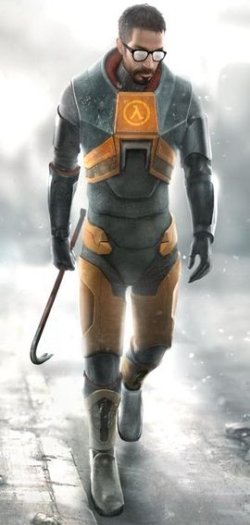
It is not always the most vocal player. However, I also played in a game of Amber where my character, Freeman, was based on the video game. He didn't say much of anything. And yet that game seemed to largely revolve around him, once the action started. Most of the other players (a strong-man, a monk, and an displaced steampunk IRA member) were out to kill him. When he took action, the universe changed, and the game with it.

It is not always the most interesting character. In a game of Cyberpunk that I played, the story was clearly from the point of view of Rolfe's character (who's name I've forgotten). Interestingly, the character himself was somewhat... drab. Certainly compared to the rest of the motley crew that accompanied him, which included a spunky mechanic, a Russian biochemist, and a cigar-smoking, wheeling-dealing fence. Rolfe's character has less social skills than the fence, no real combat skills to speak of, and didn't otherwise stand out in the crowd. He was, however, the leader of the group, and thus the story was clearly from his perspective.

It is not always the clear "leader" of the group. In a game of Continuum that I played, the main character was very clearly Liam's character Kelly... who was certainly the most interesting, but definitely not the leader of the group. Heh. No, he was as far from the voice of reason as is possible. : )

It is, however, the character most central to the plot. But to say so is somewhat redundant, since that's pretty much what defines a main character. : )

This theory does not universally apply. I ran a very large game (eight players at any given time), which (interestingly) ended up more as an ensemble, where a few of the players stayed on the fringe, but the others each had their moments in the limelight. No one player contributed enough to be considered central to the plot or to the gaming. ...It was a relatively unstable group, however, (heavy on the "drama") which may well have affected things.

I wanted this to be more of an exposition of an idea than a commentary about its effects. Yet I feel compelled to say one thing that I've learned because of this: it is more important for the players to be forewarned about this tendency than it is for the GM.

Game Reviews


Assassin's Creed summary: play it.

It's a short game. It crashed on me about a dozen times. It ends with a "there will be a sequel" scene. It was too easy. It was fucking violent: snapping legs, watching an innocent get stabbed 30 times, and worse. The whole "present day" storyline was superfluous. The controls take some getting used to. You have a very hard time identifying with the main character, on account of his being a pig-headed prick.

All that aside, the experience is awesome. The roof-top chases alone are worth the fifty bucks. This game accomplishes things no other game can. Personally, I hope the Looking Glass folks get their hands on this engine and make a worthwhile sequel to Thief II.

I finished the game one day before The Orange Box arrived... and it's a damn good thing, too, 'cause now that I have Half-Life 2 (HL2) back, I can't stop playing it. Screw the other games in the Box!

I haven't had much time to play, so I'm only as far as the big bridge scene. I was worried that I would get my ass handed to me, since I'm used to PC gaming, and the controls are very different. ...but I am proud to report that I have not died once. Before every scene, I kept telling myself, "there's no way I'll make it through this without dying." Yet somehow, I limped through.

I'm positive I'll fall off of the bridge a few times, though.

I find HL2 to be a perfect game: moody, dark, detailed, creative, immersive, frightening, charming... I'm addicted to it. It is the best game of all time. I don't mind the linear nature of it at all: it's like playing a (superb) movie.

Epic Play

I've been thinking about Epic D20 play, since it's something I've always wanted to try. In theory.

Part of my "thinking" has included looking through some epic-level play handbooks. The problem that I'm quickly seeing is in the attack stats. You've got to hit bonuses of, like, +77 or +123. The problem here is that the spread is too high: either you're going to be hit every time, or you're going to miss every time. That's lame.

The damages are also really annoying: 12d6+50? Who wants to roll that kind of damage? You're supposed to be playing, not doing math.

I still like the setting. Extraplanar travel and epic-level creatures are both super-cool. But the System breaks down at those level. You've gotta switch System to something more appropriate, once you get there, or the game will devolve quickly. Or so I hypothesize. And the fact that I've only ever heard of one epic-level game, ever (and the stories were always about how broken it was), suggests that most people seem to agree.

And, no, I'm not interested in Scion. ; )

Coolest Setting Idea

One of the coolest ideas that I heard from indie roleplayers was a setting idea: a captive tarrasque . (If you don't know what one is, this post will be lost on you. Move on.)


Some ages ago, a collection of very powerful mages managed to lure the tarrasque into a trap... for example, completely buried underground, in hard stone, with magical bonds around each limb. The tarrasque was left to rot and the area abandoned and made off-limits to the people of the time.

...But that time has passed. Some years ago, the tarrasque was discovered by a less-than-scrupulous mage. He has decided to mine the tarrasque.

Yes, to mine it.

He's dug an underground laboratory to one side of the tarrasque, and bored a hole through the rock to the tarrasque's back. Periodically, they cut into the tarrasque with a horrific contraption, and harvest what organs they can, capturing as much blood as possible in the process. The beast makes muffled screams from within the rock, and there are occasional quakes as it writhes in agony... but its unmatched restorative powers always return it to full health. ...And then the mages begin again.

...Clearly, there are plenty of opportunities for PCs, here. Some ideas:

  • Someone hires them to steal some of the curative blood, without knowing its true source.
  • An enemy kingdom hires them to stop the production of the curative blood.
  • The PCs are asked to negotiate with the mages for the blood (without knowing the source), in return for some resource they represent.
  • The PCs are touring the facility, when one of the bonds breaks... they need to act immediately to stop the tarrasque from escaping.
  • The blood is making people progressively more evil. A patron of the PCs is using it, and they notice his changes, investigate the reason, and discover the operation.
  • Cultists (PITA?) are en route to free the tarrasque. The PCs must stop them.
  • When the PCs discover the operation, one of the NPCs with the party decides this is cruel, and tries to free it. Will they turn on their own party member to save the world?

Amber Quotes

Just doing a dump of quotes that I kept during our last Amber campaign:

"So, the plan is to sneak into the castle and find Dworkin. If he looks trapped, free him. If he's having tea and crumpets, kill him." -- Andre

"You're going to hell." -- Psalm... just about every five minutes.

"Okay, I will trust in Uncle Brand." -- Jeremy
[jumping out of chair:] "I WON! I WON!" -- GM

"You'd have to open your legs a bit wider for an old man like me." -- Dworkin, to Andre.

"I just have to say, that's the boldest thing I've ever done in a role-playing game." -- Jeremy
"What, sleeping with Fiona?" -- Sarah

"Since Brand is dead, I put him down." -- Andre.

"The Pattern is Dworkin's brain. ...Like, on fucking drugs." -- Prince Random

"Exactly how many Hellmaids have you 'parlayed' with?!?" -- Todd, to Psalm

"Here's my plan: 1) save the universe. 2) Deal with Freeman. 3) Figure out Random. 4) Go insane and plant corn." -- Andre.

Best one of the game:
"I jump off the stairs [of Tir-na-Nogth]." -- Liam/Psalm
"Wait, do you know what happens?" -- Sarah
"Sure: gravity pulls me down... but I have Dierdre's trump!" -- Liam
"You'd better hope she's out of her coma!" -- Rob
"Wait, she's in a fucking COMA?!?" -- Liam, who had missed the previous session...

"The only way Freeman will survive is through his sperm!" -- Todd

"...When we're done, we can finally put Oberon, Brand, and Freeman to rest." -- Andre (Freeman wasn't dead.)

"So, Todd's trump suddenly turns into a pressurized hose, spraying water that knocks Todd down, lands a few feet away and continues to spray like a geyser." -- GM
"I point it at the primal pattern." -- Rob, seeing the blood all over the Pattern
"Wait, NO!!!" -- Rob, realizing that's BLOOD ON THE PATTERN

"You see Lewella swimming downward, going deeper and deeper..." --GM
"Lewella, are you near a doctor?" -- Todd

"What harm could Freeman do? He was outmaneuvered by a horse!" -- Lewella

"Give me my souls!" -- Baby demon
[pointing his pistols:] "Come'n take em, ye lil twat!" -- Psalm

"Who told you that?" -- Psalm, to Florimel
"Freeman's man..." -- Flora
"The bald guy with the cats?" -- Psalm

"After all the good work we've done here with the flamethrowers, I think this is a safer place!" -- Flora

"...Like Zen, for example. Complete and utter bullshit, and yet it exists in almost every world." -- Ygg

"I'm afraid I have to disagree with you on that..." -- Andre
"What, you like your nipples?" -- Ygg
"Yes."
"But why? You're male--they are completely useless! What purpose do they serve?"
"They give pleasure."
"Please demonstrate!"

"Todd's gone mad, destroyed Ygg. Chaos winning!" -- Andre's update to Corwin
...And those were perhaps Andre's last words. ;)

Amber Campaign Idea

Wouldn't it be interesting to play in a post-apocalyptic Amber game?

Brand won. The others couldn't stop him. Reality has been re-shaped in his image. Of course, the elder Amberites are still all around: Brand would want to gloat. But here's the rub: Ygg has moved, and now its the Amberites that cannot cross the boundary between the realms.

Some of the Amberites have managed to find love--or at least momentary pleasures of flesh--in the demented reality created by Brand. Some children have come of it. ...And the children, it seems, do not have the curse of their parents: Ygg is no boundary for them.

Now, with the aid of the elders, the younger generation begins making forays into Brand's Golden Circle, to learn what they can of the fate of the multiverse and, hopefully, find a way to reverse it.

New Powers:

Shadow Pattern
. Because there is no "true" pattern to walk, the grandchildren of Amber will receive their ability to move through shadow from their parents, by walking a pattern in their parent's mind, through a strong psychic link. Their ability to shape shadow using this power is greatly reduced, however. With this ability, the user still has the power to affect probability, but only one small effect at a time--all other factors change independently. Thus, if the player chooses to make a pistol appear on the tabletop, he may inadvertently also change the color of the sky. This power also acts like an involuntary Shadow Trail: if reality changes around a user of this power, they will be pulled along with the change. (This is to ensure that one player's changes never isolate them from the other players unless they have significant geographical distance.)

Trump. The players may not take Trump powers: Brand has complete control of Trump, so using it would immediately alert him, and likely result in their immediate death. The Elders have taught their children to fear Trump absolutely.

Shadow Dispersal. Brand was clever, but not quite clever enough to completely erase the Pattern's predecessor, the Unicorn. She is now working, in secret, to restore order to the universe, and to this end has developed a power that momentarily disperses shadow around the user, then "reinserts" the user in shadow in the presence of another, named possessor of Shadow Dispersal. It takes about 30 seconds of concentration to create the dispersal, during which no other actions may be taken and the user must remain stationary. (This allows players to rejoin after being separated). As a lesser effect, the user can create a miniature void in her mind, with which she may communicate to another user of Shadow Dispersal. (And, of course, this replaces Trump as a method of keeping players in touch with one another.)

Sorcery and Conjuration. These powers should be easier to use: in Brand's multiverse, magic is more uniform.

Power Words. Same.

Obsession: RPGs

It's no secret that I obsess about things. That is to say, I get all gung-ho about a topic to the near-exclusion of all else, until I burn out. Then whatever I was working on stagnates... often for many months. This autumn, I burned out on code. It's time for a lull. ...I think I'll start again in earnest in January, but at a sustainable pace. : )

At the moment, I'm burning out on RPGs. Here's a list of some that I've looked (most closely) at, and a brief comment about each of them (minus descriptions--look them up if you don't know them/care):

  • Amber: This is the paragon against which all other RPGs must measure themselves. [satisfied sigh]
  • Ars Magica: I really like the idea of playing multiple characters, but the system didn't interest me at all, peeking at it. Doesn't seem worth it: you could get the effect nicely with any number of other systems. ...Plus Ars Magica is all about spellcasters, which I am not enamored with. I feel a little guilty passing on this one, since it comes so highly-recommended, but... so does HeroQuest, and you won't see me playing that, either: not my cuppa.
  • Battleaxe: Wow, amazing, amazing book. ...But it's a standard hack-and-slash fantasy game, and everyone who cares to play those plays D&D already, so why would this system ever get considered? ...Because it's free? ...How many D&D players do you know who don't already own at least five D&D books? [shrug] Laudible effort... wrong nieche.
  • Blue Planet: Okay, I own it... but wasn't impressed with what I read: waaaaay too equipment-heavy. Still, it's idea-fodder.
  • Burning Wheel: Neat! I bought this one already (actually in a case of mistaken-identity: I intended to buy Nine Worlds), and I'm surprisingly pleased. It's yet another fantasy kind of thing... but it's elegant: a simple system with loads of detail. Also a great value (as I said earlier) at $25 for two nice books. I've browsed them, already, but now I'm giving them a proper read, and finding I rather like it. As I said earlier, though: I doubt I'll ever play it. I'm still happy to own it. Great character-creation system (if a little rigid compared to, say, FATE).
  • D20: [sigh] Do I have to?!? D&D would be great, if it didn't focus so much on feats. Or levels. Or classes. Or half-baked skills. ...So that leaves... ummn... really handsome artwork? Yup. ...I still like the books: superb idea-fodder. Honestly, the books are best-of-breed in that respect.
  • Dogs in the Vineyard: I have it. I've digested it. I like it (a lot). ...but I really need to see it in action before I commit myself to it. It still seems like it could be great, though. I'm not a Western kind of guy at all, so I would play this as more of "Druids in the Vineyard" (a straightforward conversion with deserts to forrests, coats to cloaks (or staves), and guns to magical weapons), but it still seems fascinating.
  • Donjon: kinda neat, for what it acomplishes... but I'm not a big fan of dungeon-crawls, in general. I would play it, if there was interest. ...I wouldn't run it.
  • Everway: Very cool. Light, detailed, and inventive. Too bad it's dead. : )
  • Final Strike: kicks ass, for a lazy sunday night one-shot! Funny sourcebook, easy enough to learn. Interesting mechanic.
  • FATE: I adore this system--I think it's one of the best dice-based games available. I really consider this system "mine". ...meaning, when I think of running a game, this is the second one that pops to mind [cough Amber cough], and when I think about designing a game, this is the first system that I think to emulate.
  • Firefly: Like GURPS, but simpler. It still seems broken to me, and I still think multiple other systems would work better for the setting... notably Dogs in the Vineyard and FATE.
  • FUDGE: I love the mechanic. I dislike the detail. Play FATE, instead.
  • GURPS: I've seen it broken, so I would rather play something else. I've also seen it take five minutes just to calculate all the modifiers for a single roll in combat. How is that fun?!? I'll pass. ...Nice sourcebooks, though. : )
  • Great Ork Gods: A "joke" of a system, perhaps, but it's an awesome joke. ; ) Another "lazy sunday night one-shot" system.
  • Mountain Witch: a whole lot of hootin' and hollerin' over this game, and yet the mechanic is "roll 1d6. The highest roll wins". What ... the .. fuck?!? Why not just play DICELESS?!? (...I will say: I do like the "standoff" mechanic, in concept.) Still wanna play the setting? Play Dogs, but use the Code of the Samurai. Relationship dice match well to Trust, and players make their own Fate as they go. Rock on.
  • My Life With Master: This appears to kick ass, but I don't have it yet. I'll grab it early next year.
  • Nine Worlds: I just ordered it... and it sounds like it kicks even bigger ass. I'm really itching to get my hands on it!
  • Nobilis: Yum. It's not Amber... but close. And the book is just... yum.
  • Paladin: I really, really like this sytem! It allows to open-ended "super" powers, it's very, very simple, and it matches its theme effectively. I love the first half of the system especially... it starts to fade for me a bit after it goes into redemption and the penalties for going Dark. ...it seems to me it should be a constant temptation to go Dark, rather than "I'm out of Light, so I have to". [shrug] I'd have to see it in play for final judgement.
  • Polaris: I'll tell you about it when it comes in, if the spirit moves: I just ordered it yesterday... but it sure sounds spiffy. I made a character for it, once... and I loved that character, but never got to play it. ...So my hopes are (very) high.
  • Pool: Staple. I will definitely play this again, if not "as often as I can get away with it". Absolutely elegant: right to the point. 10-minute chrgen with enjoyable, serious play (as opposed to the Great Ork Gods / Risus / Final Stike kind of one-shot silliness). A gem of a game, for free!
  • Puppetland: I'm actually really itching to play a game of this! Demented and oh-so-cool. It's rules-light, and a friend has a copy, so I'll just borrow it and digest, rather than buying (though it's quite cheap).
  • Risus: Spiral of death makes this not-worthwhile, though I love the "heft" (or lack thereof) of the game. Still, I'd rather play The Pool.
  • Savage Worlds: I'm sure this would be fun, if I were a Gamist hack-and-slasher. I'm not.
  • Snowball: I actually helped playtest this one, back in the day, and really enjoyed it! ...but now that time has passed, I am less enamored with it. It's upfront about being a gimmick... it's the kind of thing you'd play once or twice, just to say you did. And I did. In fact, my chr, a crow, was perhaps the coolest chr I've ever made. Ever. But still, it's just a variation on The Pool... so... I'll just play Pool. : D
  • Sorcerer: I dunno. I didn't like it. Perhaps it's the focus on magic, again. Maybe the game seemed too gritty and negative. But it just didn't float my conceptual boat. I could get in trouble for saying as much, as it's Ron's game, and Ron is The Man. (Really: he's a genious and I love his game reviews: they always seem to resonate with what I like in a game...)
  • Soap: Lots of hype about being a cool, intriguing system. ...but I simply cannot bring myself to play a game based on Soap Operas. Sorry.
  • Trollbabe: Neat idea. ...but not neat enough to make me buy it. The idea can be captured with another system. (Paladin comes to mind.)
  • Universalis: Greatest world-building system ever... and I will always use it as such, period. (I honestly wouldn't consider running a game without using this first to develop the setting) ...now, for actual game-play, on the other hand... no. It's really less of an RPG and more of a "book-writing by consensus". ...Which is neat. ...or, it would be, if I were a writer. : D But the system is still a staple, and every gamer should own a copy.
  • Unknown Armies: Seems superflous to me with Nine Worlds around.
  • Urge: based on Sorcerer, and (IMO) quite a bit cooler... but again, it's perhaps just a bit too negative for me.
Believe it or not, I've actually looked at a whole lot more than this list, but discounted them out of hand for various reasons: a setting I don't like, too complex, or known-to-be-broken. My list is long enough that any reason to cull a system is valid!

...Which leads to the next point, which is: what are my choices? What systems will I lean toward, in the future? An enumerated list, in order of preference:
  1. Amber. (Duh.)
  2. FATE.
  3. Universalis. ...kinda. (Again: only for defining the setting.)
  4. The Pool.
But there are a number of contenders I have yet to test-drive:
  • Dogs In the Vineyard.
  • Paladin.
  • Puppetland / Final Strike / Great Ork Gods (ie: silly, light, one-shot fun)
  • My Life With Master Update: read a thorough review--decided it was too light a system.
  • Nobilis
  • Polaris (Update: bought it, read it, too weird.)
  • Nine Worlds (Update: bought it, read it, too greek!)
I hope to have all of the systems by the end of January... and to play each of them over the next year or so.

...And that's not to say I won't play anything else: I will. ...I'd just rather not. : D

Role-playing is one of the best hobbies available! It's social, it's cheap, and it really gets your imagination pumping. It's also (usually) filled with humor. There are penalties to pay for doing it (meaning it's widely considered lame by normals and it's damn frustrating when you can't play for weeks on end)... but on the whole, I'm quite happy to be a Gamer.

Busy

I've worked about 35 hours in the past 10 days, in addition to my normal 40-hour job. When I'm not working, I'm a vegetable: parked in front of the tube, reading a book, or playing Oblivion.

I could certainly have worked more, but consciously chose to break away every now and again: I'm trying dilligently not to burn out. ; )

Following through with my motto of "finish", I have, in spare time, tried to finish watching Scrubs, actually finished Oblivion (albeit using the god-mode cheat, and I was much closer to the end of the game than I thought I was), and reading my Ruby on Rails book (and actually digesting it this time instead of breezing through).

I've also come to the realization that "Finish" is more often a case of "Don't start", so I have been focusing on a few projects at work rather than taking on all of the new opportunities I see crop up everywhere. ...Without going into details, I will say that my last week or two at work has been very, very positive.

Although I would be lying if I claimed I'm not looking forward to a lighter load (which I should have in about a week), I must also admit that I'm actually enjoying having such a full schedule. ...To a point. :)

And, of course, I am refusing to let my full schedule interrupt my Sunday-night role-playing game. We're still playing Continuum, though the plan is to wind this down in the next few weeks, and move to some form of Firefly. (I'm hoping we choose Dogs in the Vineyard as a system--I just ordered the book through mail, though it hasn't arrived yet.)

And the dog is freaking out about DST ending: she's presently bugging me about supper, and she has another two hours to go. : )

More on RPGs

Here's a confession: I never, ever do hit points. Ever. I just declare "you killed it" when someone does damage andd the group is starting to get anxious about the combat.

There are wildly differing opinions on this, and I'm in the minority, but: I believe that it's the GM's job to keep the players alive. (And, yes, there are obvious exceptions.)

D&D can be made not to suck in one of two ways: playing it like it's meant to be played (hack-and-slash treasure-hoarding), or totally ditching the system and concentrating on the role-play. It has a wildly creative setting: it sets the imagination alight. I think it's a great way to escape, on the role-play end of things.

It's also great eye-candy, which is why I've gotten into the miniatures game. (Fucking expensive game, though.)

Other board-games are fun and much easier to arrange with people... but doesn't scratch the itch. At least D&D miniatures does, mostly.

[ponder]

You know, I don't think there's any such thing as a satisfied GM. Players are never focused enough, the world is never detailed enough, the system is never effective enough. The GM's lot is a lowly one.

GMing

A friend asked me

When you are GMing, do you wing it, or come up with solid plans and subject matter (then wing it if the players take a different direction) or do a combo of the two?
I wing it.

However, I spend a lot of time thinking about the game between sessions. Occassionally, I'll scribble down a few ideas, but generally I leave big decisions about the direction of the game for the morning before, and mull it over through the day. By then, I have a reasonable idea of the main themes: interesting NPCs, interesting settings, and some "plot tricks".

My current GM plans heavily, and it pains me. He spends hours each week preparing for the game, going so far as to print things out, put things in folders, prepare NPC monologues, review all the PC character sheets, etc, etc... But then when the players blow the plan, or glance at the printouts and toss them aside, I think to myself, "Why bother?!?" I feel like my GM is wasting most of his time, and I worry that his feelings are hurt because of it.

On the other hand, I've seen other GMs "wing it", where it didn't work... So perhaps it depends on the GM.

But besides that, the best sessions I've ever played (as opposed to run) were in games that were made up the hour before the game started! ...I used to be into the "independent RPGs" community. ...Generally, we were playing a new game every week. Coming up with the game world was usually half the fun.

I will admit, however, that the wing-it method does make for some awkward pauses: the group has completed the session's themes, isn't motivated to do anything, I don't feel like throwing random encounters at them, and I'm not sure what to do next.

But RPG sessions are usually so casual, that these pauses seem (mostly) to be construed as "time to grab some munchies and chat with friends I haven't seen in a week"... So there's time to think up stuff while the social aspects take over.

In my experience, that's the worst part of RPG'ing as adults: it's so hard to see one another often enough to game that it's the only time you see one another... And the temptation to just "visit" is super-strong. It wasn't a problem in school, because you saw these people nearly every day.

Anyway, I find that prep time is directly realated to frustration with the game. The more effort you put into your game, the more disappointed you are when the group isn't really "into" it. ...Most of the fun of RPG'ing comes not from the GM, but from the dynamics of the group. Let them do the work: you just facilitate.

An Age-Old Roleplayer's Lament

Found this on a WotC page:

A famous baseball radio announcer once claimed that anyone who tuned into his show hated him and every word he said until he gave them the score. I think it’s a little like that in a way for D&D players. Each game session, players can seemingly resent every plot and subplot, they hate every NPC, until finally the sweet release of combat comes heralded in by those two wonderful words: Roll Initiative.
...This is one of the main reasons I dislike D&D.

Mind you, I'm a biug believer in the old writer's adage: start with important action. As true in RPGs as in writing. But the assumption that D&D is nothing but a combat system... that bugs me.

Of course, this comes down to the age old debate of Naritivist/Simulationist/Gamist theory. But the assumption that D&D must be Gamist all the time is what wrecks it for me.

[sigh]